A church built, lost and built again
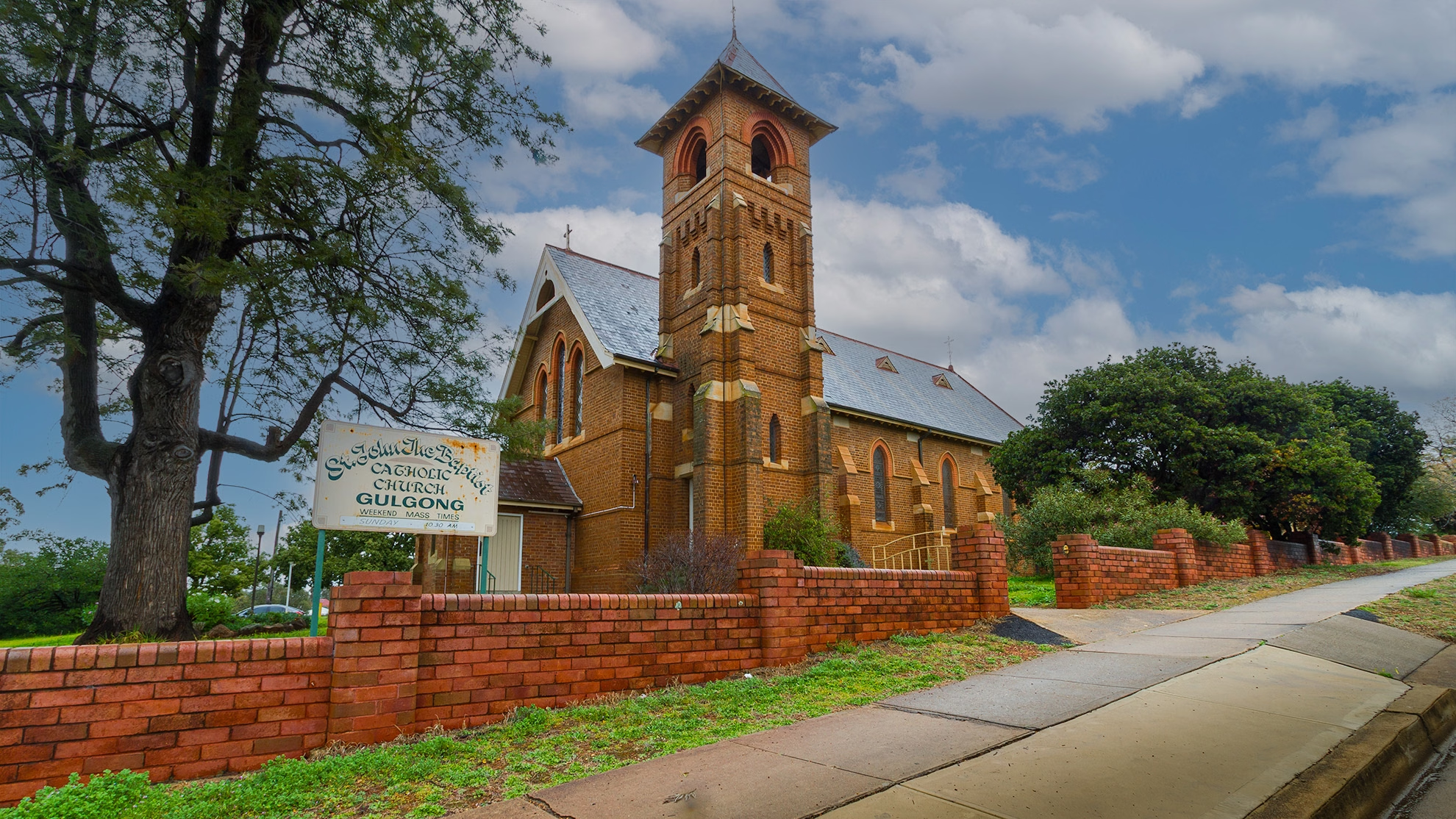
Standing on Bayly Street, St John the Baptist Catholic Church is one of those buildings that seems to belong naturally to Gulgong.
Its brick walls and church tower have looked across the old gold town for generations. Yet the church we see today was not the first Catholic church to stand here.
Its story begins with a much humbler timber building.
A church for a gold-rush town
Gold was discovered at Gulgong in 1870, and the settlement grew at a remarkable pace. Miners, traders and families poured into the district, while new shops, hotels, houses and places of worship appeared among the busy streets.
The Catholic community was quick to establish itself.
By November 1871, newspapers were reporting that a “handsome Catholic Church” was being erected in Medley Street. A tea party and musical evening were planned to help pay off the building debt, proving that fundraising has been part of church life for a very long time.
The new church was built entirely from timber, but it was clearly more than a rough goldfield chapel.
A newspaper description from 1872 praised its graceful appearance and remarked on the sense of strength and permanence it conveyed. The church stood on a large fenced allotment, where children attending the Catholic school could be seen playing.
It is a lovely picture of early Gulgong: a timber church, a rough paling fence and schoolchildren playing outside while the town grew around them.
Photographs preserved by the State Library of New South Wales provide another glimpse of this first church. The library identifies it as the Wooden Catholic Church, 1871–1885, situated at the corner of Medley and Bayly streets.
Church, school and convent
The early church was not simply a place for Sunday worship.
It also became part of a small Catholic precinct where faith, education and community life met.
The Sisters of St Joseph arrived in Gulgong in January 1883. Their first convent was a modest four-roomed cottage, while an old shed was used as a schoolroom. These early arrangements were simple, but they laid the foundations for the larger convent and school buildings that followed.
Then, only two years later, disaster struck.
The storm that destroyed the church
In January 1885, a violent storm swept over Gulgong.
One newspaper report said the storm lasted only a few minutes, yet damaged buildings throughout the town. The Catholic chapel was blown to the ground.
Later recollections described the lost church as a fine and spacious wooden building. With their church gone, parishioners temporarily returned to the old school building for worship.
But the Catholic community was not prepared to leave things that way.
Within weeks, plans were announced for a new church to replace the building destroyed by the cyclone. A January 1885 report said that Monsignor Byrne would lay the foundation stone and that the plans had been prepared by Mr Gell of Bathurst. The proposed building was expected to cost about £3,000 and was predicted to become an ornament to the town.
The intention was clear: the next church would be stronger, grander and more permanent.
The puzzle of the present church
This is where the history becomes a little complicated.
One modern church-history catalogue says the present church was built in 1885 at a cost of £2,250. It describes the building as red brick laid in Flemish bond and says it replaced the earlier church erected during Gulgong’s first gold rush.
Other historical accounts tell a longer story.
A detailed reminiscence published in The Catholic Press in 1929 says the parish used the old school after the cyclone. It recalls that construction of the present brick and white-stone church began early in 1890, after the contract was awarded to builder G. Turner. According to that account, the church was blessed and opened by Bishop Byrne on 14 December 1890.
A contemporary newspaper report from 1900 adds weight to the 1890 opening date. It describes celebrations marking the tenth anniversary of the opening of St John the Baptist Church.
Perhaps the safest way to tell the story is this: the old timber church was destroyed in 1885, the rebuilding effort began soon afterwards, and the church associated with today’s building was formally opened in 1890 according to the detailed parish reminiscence and the tenth-anniversary report.
History is not always as tidy as we would like. Different records may refer to the foundation stone, the beginning of the rebuilding campaign, the construction itself or the official opening.
What is certain is that the loss of the timber church marked the beginning of a much more permanent chapter.
A bell rings across Gulgong
By 1900, the new church was a familiar part of the Gulgong landscape.
On Sunday, 25 November that year, parishioners gathered to celebrate its tenth anniversary and hear a magnificent new bell officially rung for the first time.
The bell cost £146 and was donated by five people. It was hung in the church tower, which stood on a hill overlooking the township.
The celebration drew people from Gulgong, Mudgee and surrounding districts.
The church was decorated for the occasion and filled with a large congregation drawn from different denominations. A visiting priest opened a week-long mission, while the choir performed music from Mozart and Haydn.
One can imagine the sound of that new bell carrying over the rooftops and winding streets of old Gulgong.
It was more than the arrival of a new church fitting. It was a sign that the parish, once left without a church by a violent storm, had firmly established itself again.
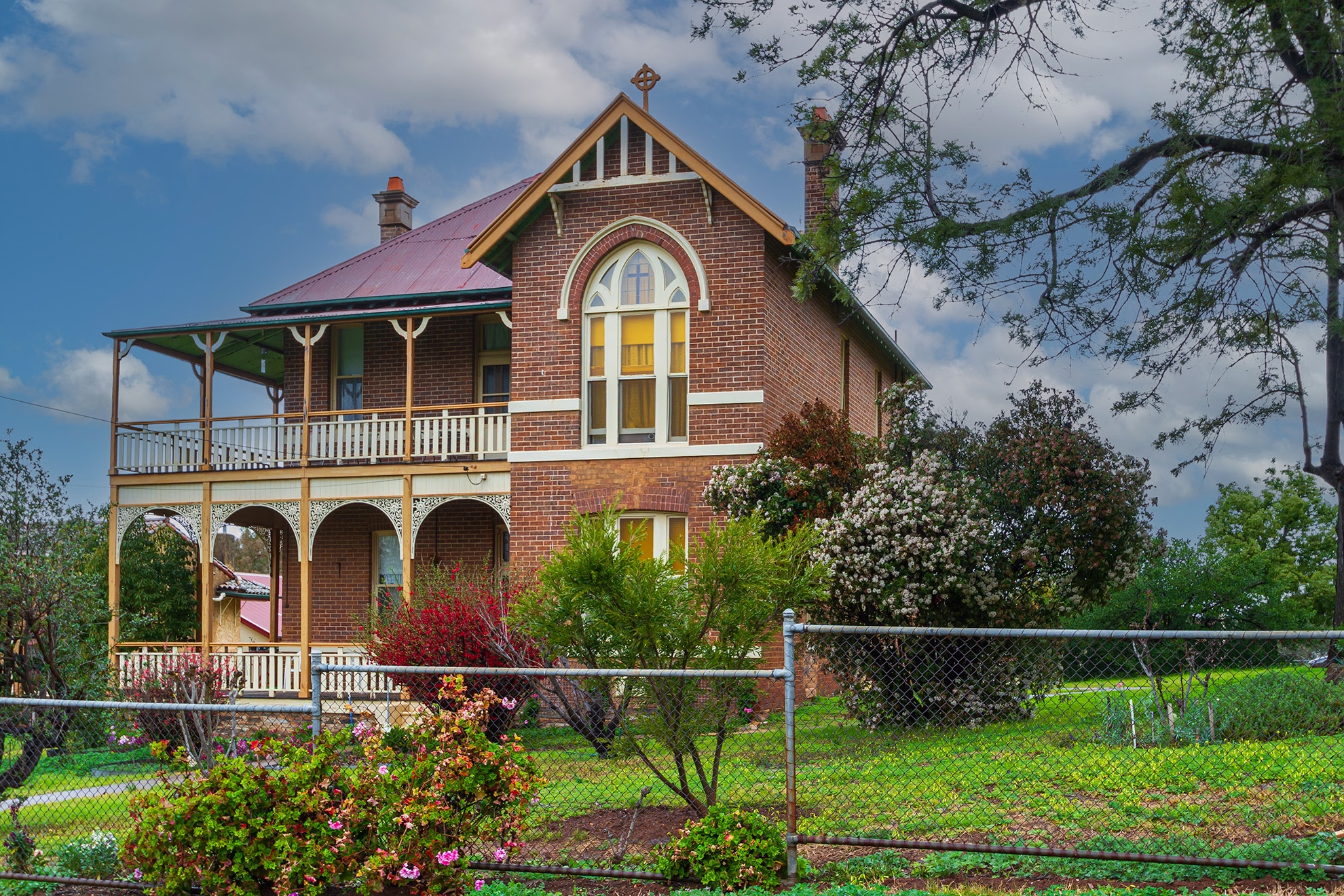
The presbytery and parish buildings
The church was only one part of the developing Catholic precinct.
A historical account records that Bishop Byrne laid the foundation stone for a rubble-and-freestone presbytery around 1897. The building was opened the following year.
Fundraising continued after its completion. During the 1900 bell celebration, a collection was taken for the presbytery debt, raising £60 in donations.
The church interior also developed gradually.
In 1919, Mrs J. Loneragan of “Mellary” donated a life-sized mission cross. Other statues had also been presented, and a contemporary report said that the interior fittings were then complete.
Like many country churches, St John’s was not finished in a single moment.
It grew through donations, fundraising socials, working bees and the generosity of parishioners. Each generation added something to the buildings it had inherited.
More than bricks and mortar
Today, St John the Baptist remains part of the Catholic Diocese of Bathurst and continues to serve Gulgong and its surrounding rural districts.
But the real story of the church lies behind its brickwork.
It is there in the old photographs of the wooden chapel, the children playing inside the paling fence and the Sisters of St Joseph making do with a small cottage and an old schoolroom.
It is there in the storm of 1885, when the first church was blown down.
And it is there in the response of the parishioners, who gathered their resources and began again.
St John the Baptist Catholic Church is therefore much more than a handsome building on Bayly Street. It is a reminder of the determination of Gulgong’s early Catholic community and of the countless local people who helped turn a temporary goldfield church into an enduring town landmark.

Be the first to comment